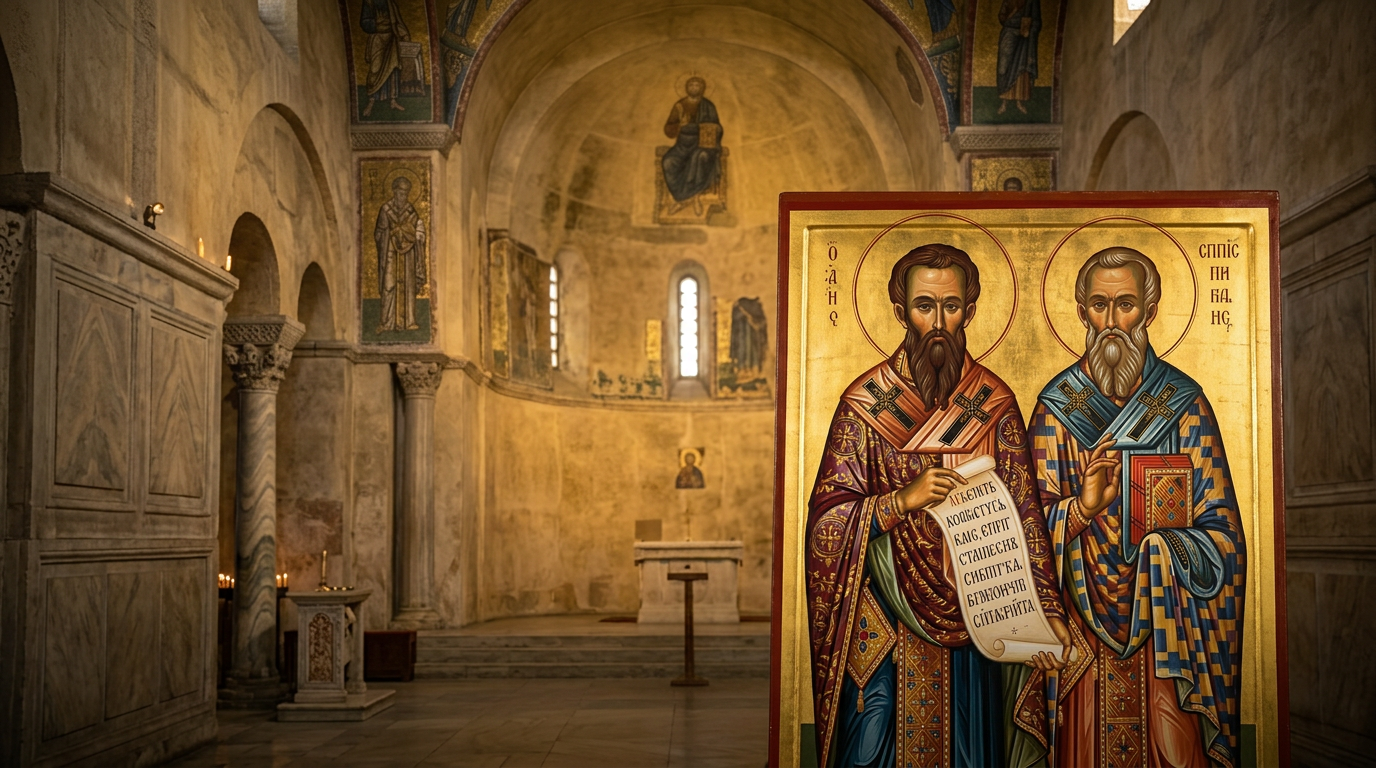
The Two Greek Brothers Who Shaped a Civilization
On May 11, the Orthodox Church commemorates Saints Cyril and Methodius, two brothers from Thessaloniki who became some of the most consequential figures in the entire history of Christianity and literacy combined.
Born in the 9th century, Cyril (originally named Constantine) and Methodius were sons of a senior Byzantine military officer. Their Greek roots ran deep, but their mission took them far beyond the borders of the Byzantine Empire. Around 863 AD, the Byzantine Emperor Michael III sent them to Moravia at the request of Prince Rastislav, who wanted Christian missionaries capable of teaching in the local Slavic language rather than Latin.
What they accomplished there changed history. Cyril developed the Glagolitic alphabet, specifically to transcribe the Slavic language and translate the Scriptures. That script became the foundation for the Cyrillic alphabet, which today is used by over 250 million people across Russia, Ukraine, Bulgaria, Serbia, and dozens of other nations. The brothers translated liturgical texts and established a written tradition for a people who previously had none.
The Church declared them equal to the Apostles, a rare honor reserved for figures whose missionary impact is considered on par with the original twelve. Pope John Paul II also named them co-patron saints of Europe in 1980, alongside Saint Benedict, recognizing their civilizational impact across the entire continent.
Their feast day is celebrated on May 11 in the Orthodox Church and on February 14 in the Catholic Church. In Bulgaria and several other Slavic nations, their commemoration is also a national cultural holiday. The two brothers from Thessaloniki gave an alphabet, a liturgy, and a literary tradition to hundreds of millions of people across more than a thousand years of history.