The Mycenaean Shipwreck Near Poros That Survived 3,000 Years on the Seabed
A Mycenaean shipwreck dating to the 12th century BC has been resting on the seabed near the small rocky islet of Modi, southeast of Poros, for over 3,000 years, and what it holds is rewriting assumptions about one of the most debated periods in ancient Greek history.
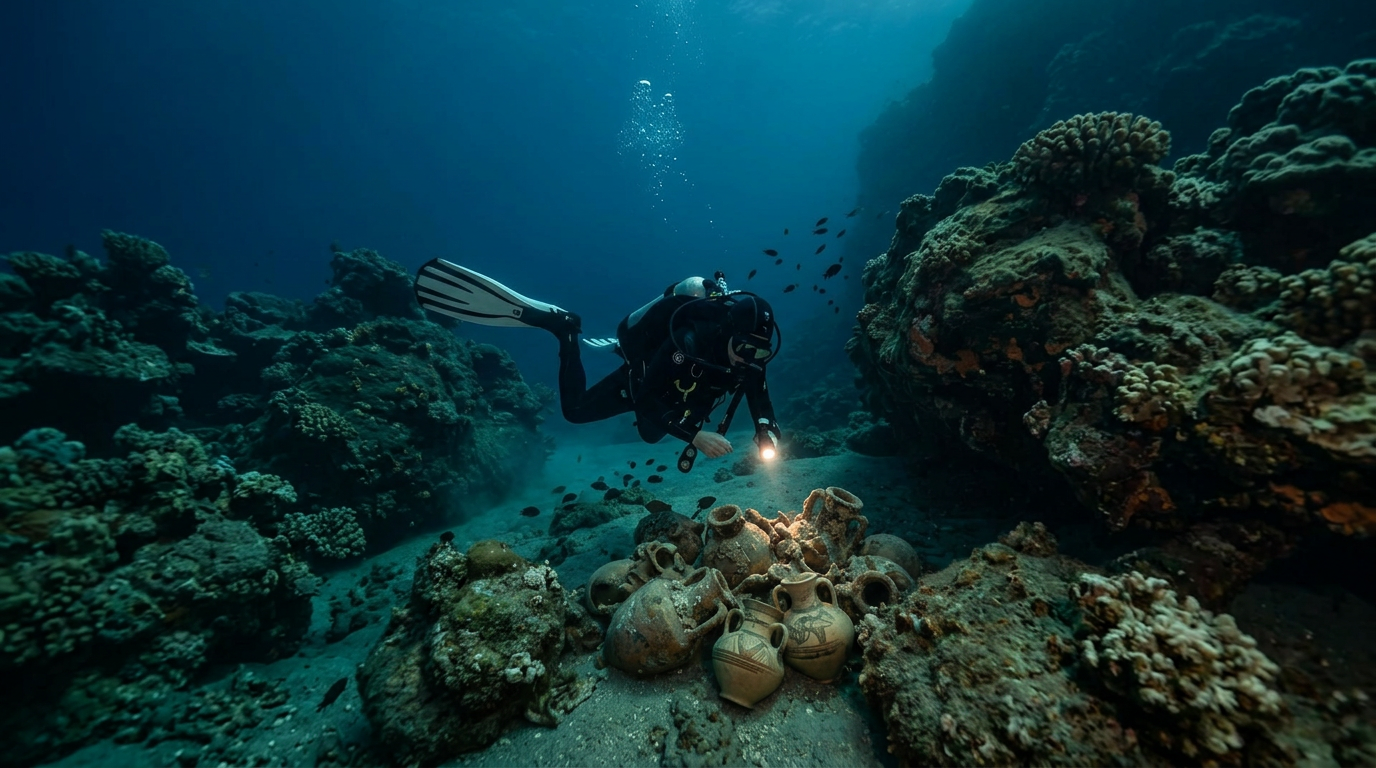
The wreck dates to the period immediately after the collapse of the Mycenaean palace system, an era long considered one of silence and decline. But the cargo found at 40 meters depth tells a different story. Archaeologists have recovered storage jars, water vessels, pottery, and everyday objects that remained completely untouched on the seafloor for more than three millennia.
"The Modi wreck proves trade and movement continued even as the palace civilization crumbled." — Christos Agouridis
Marine archaeologist Christos Agouridis has been leading the excavation at Modi since 2009. He served as a diving archaeologist with the Greek Ministry of Culture from 1989 to 2024 and is vice president of the Institute of Underwater Archaeological Research. He completed his postgraduate studies at Oxford on an Onassis Foundation scholarship, specializing in maritime archaeology and Bronze Age Mediterranean trade.
Agouridis explains that the Modi wreck proves trade and movement continued even as the palace civilization crumbled. The find challenges the idea that the Bronze Age collapse meant a total halt to human activity and exchange across the Aegean.
The excavation uses high-precision photomosaics and 3D mapping to reconstruct the wreck site without disturbing it. These technologies allow archaeologists to digitally reassemble what the ship carried and how it was loaded, something impossible with older methods.
The Modi wreck is considered one of the most significant underwater archaeological finds in Greek waters from the Mycenaean period. It is a reminder that some of the most important chapters of Greek history have been preserved not on land, but on the ocean floor.