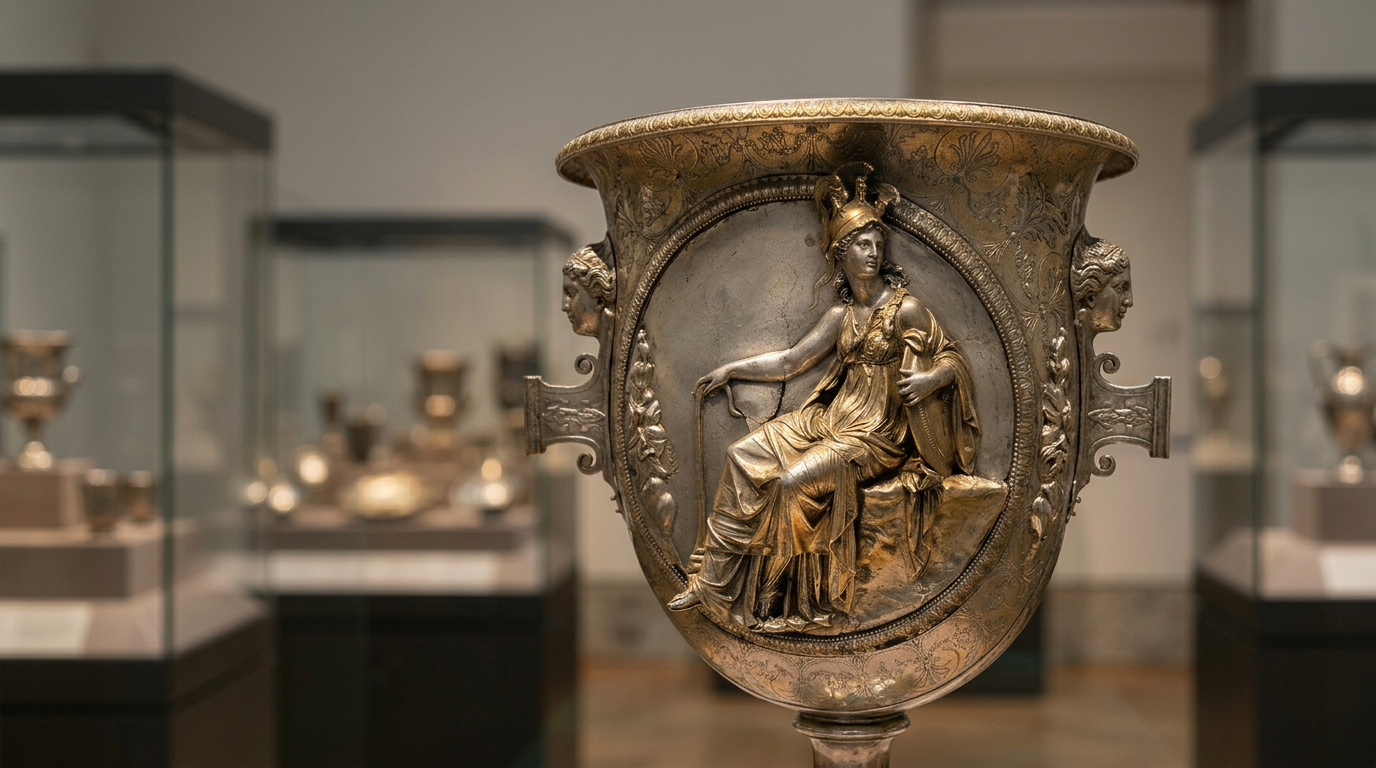
Roman Silver Buried in a German Forest. The Cup of Athena
In 1868, Prussian Imperial Army soldiers digging a new shooting range near Hildesheim in central Germany stumbled onto one of the most remarkable Roman silver collections ever found outside the borders of the Roman Empire. The Hildesheim Treasure, as it came to be known, included dozens of ancient silver objects, among them a stunning piece now called the Cup of Athena, or the Cup of Minerva using her Roman name.
The cup is not quite a cup in the traditional sense. It is closer to a wide silver bowl, roughly 25 centimeters across and weighing around two kilograms, and it is now held at the Altes Museum in Berlin. At its center sits an intricately crafted emblem showing Athena seated on a rock, shield at her side, winged helmet on her head, her sacred aegis draped across her like a ribbon. Her owl stands on a nearby rock surrounded by an olive wreath, and gold detailing runs through her robe, her aegis, and the owl itself.
According to archaeologist Gertrud Platz-Horster, the Athena emblem was likely made in the 2nd century BC, while the bowl itself was crafted in the 1st century AD to house it. Many pieces in the Hildesheim collection showed signs of wear and repair, suggesting the collection was assembled gradually over time.
Experts believe the treasure was buried by a senior Roman military commander, likely hidden to keep it from falling into enemy hands. The leading candidate has long been Publius Quinctilius Varus, the Roman general who lost three entire legions at the Battle of the Teutoburg Forest in 9 AD, one of the most catastrophic defeats in Roman military history. According to the Roman historian Suetonius, Emperor Augustus was so devastated by the loss that he reportedly cried out, "Quinctili Vare, legiones redde," meaning "Varus, give me back my legions." Varus died by suicide after the defeat rather than face the political fallout, and Augustus abandoned all plans to expand Rome into Germanic territory.
Another theory holds the treasure was looted by Germanic tribes and buried by them. Either way, the Hildesheim Treasure stands as one of the most important collections of Roman silver ever discovered anywhere outside the Roman Empire's borders.