Archaeologists Find Odysseus’ Name Carved in Stone on Ithaca
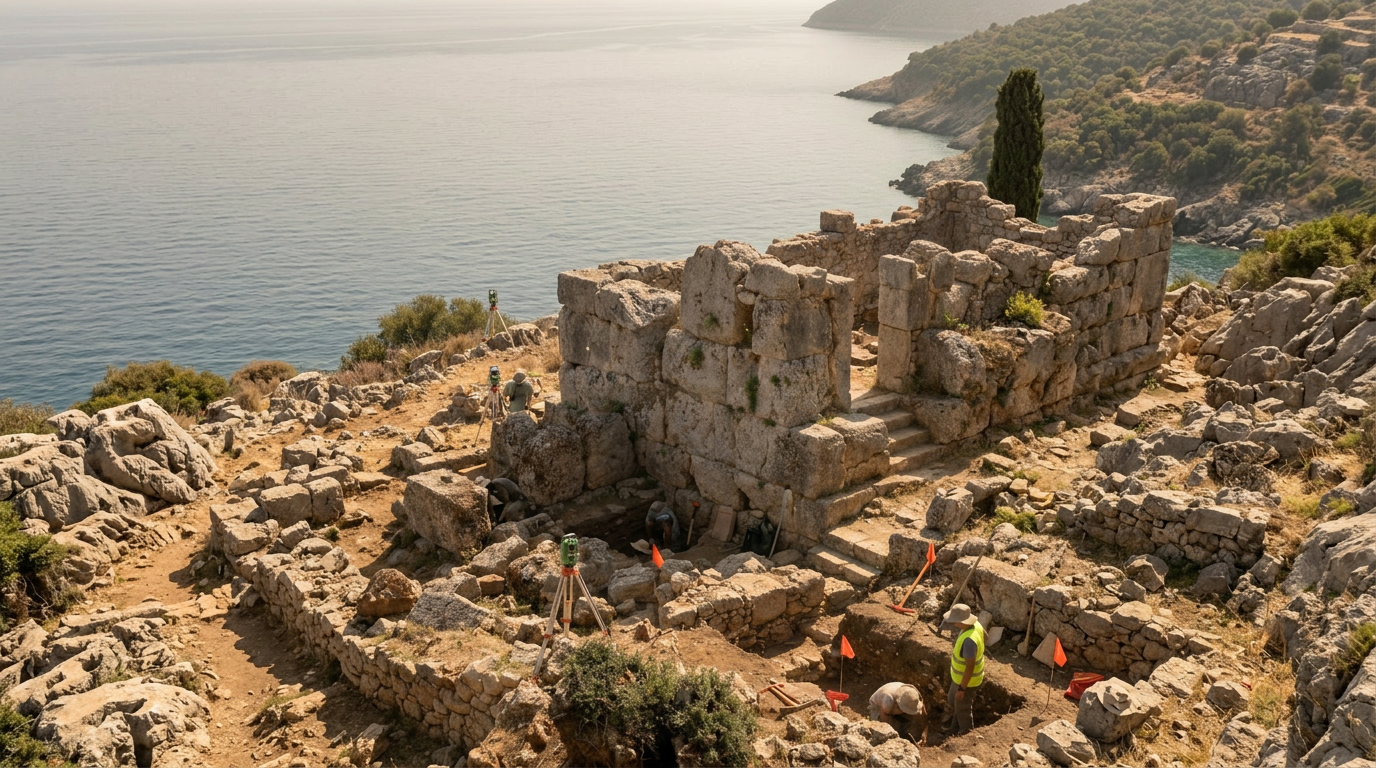
Archaeologists excavating the northern coast of Ithaca have uncovered inscriptions bearing the name of Odysseus himself, adding serious weight to the island's claim as the hero's homeland. The finds come from the site of Agios Athanasios, also known as the School of Homer, where digs have turned up evidence of continuous human activity stretching back to the Final Neolithic period, roughly the late 5th and early 4th millennium BC.
Among the most striking discoveries are two stamped roof tiles carrying the name [OD]YSSEOS in the genitive case, essentially meaning "of Odysseus," and a second inscription in the dative case reading ODYS[SEI], which researchers believe may be a votive offering from a pilgrim. These are not casual graffiti. They appear on official-looking stamped tiles alongside other inscriptions referencing Apollo Agyieus and markers of public ownership, suggesting this was a formal sanctuary complex dedicated to the legendary king.
The broader haul of artifacts is considerable. Excavators recovered 34 fragments of clay votive offerings, over 100 Hellenistic and Roman coins, a small hoard of gold jewelry, dozens of loom weights, and 14 inscribed tiles with Greek and Latin text. One tile carries the letter delta, likely an abbreviation for "public property." The underground cistern found at the site dates to the Mycenaean palace period, and a Hellenistic tower from the 3rd century BC also stands on the grounds.
Researchers now believe this complex can be confidently identified as the Odysseion of Ithaca, a monument referenced in a 207 BC decree from the municipality of Ithacans found in Magnesia, in what is now western Turkey. The identification has been debated in academic circles since the 1930s, but the combination of architectural, ceramic, and inscriptional evidence now makes the case substantially stronger. Archaeologists also noted that a palace structure identified as belonging to Odysseus was found on the island back in 2010, adding another layer to the historical picture.
The local municipality has announced it wants to fund further excavations and support the protection and promotion of the site.